


Long live Texas.
A state built on self-reliance, independence, and resilience.
So why are 5.3 million Texans food insecure?
Texas boasts approximately 125.5 million acres of farms and ranches, the largest agricultural land base of any U.S. state, generating billions of dollars in agricultural output each year.
Yet Texas faces one of the highest rates of food insecurity in the nation. In 2023, approximately 5.3 million Texans (17.6% of the population) lived in food-insecure households. Nearly three-quarters of a million Texas families were forced to change the way they eat or reduce food intake altogether. More than 1.6 million children, nearly one in five, lived in households struggling to put enough food on the table.
Texas is not alone.
The problem does not stop at the border.
California, despite being politically, culturally, and geographically distinct from Texas, faces the same paradox. It produces more than one-third of the nation's vegetables and three-quarters of its fruits and nuts, with agricultural sales totaling $59 billion in 2022 and $22.4 billion in exports in 2023. Still, for 1.4 million California children, this abundance remains out of reach.
How do some of the most productive agricultural regions on Earth still struggle to feed their own people?
Two very different states.
The same paradox:
Abundance everywhere. Hunger everywhere.
For decades, hunger policy has focused on food insecurity rates, funding levels, program eligibility, and access to food. These outcomes matter. Yet they often leave unexplored the systems that shape those outcomes.
Today's Rabbit Hole explores what happens when a society becomes so focused on measuring outcomes that it stops examining the systems that produce them.
Let’s Jump In. 🕳️🐇🕳️
If America produces so much food, why does hunger persist?
Historically, the dominant way of understanding hunger has been through the lens of food security. The focus has been on whether families have enough food at any given moment.
This perspective answers an important question:
Do people have food today?
What it does not answer is an equally important question:
Why do some communities remain vulnerable to hunger despite living amid extraordinary abundance?
A grocery store shelf may be full. A family may have food on the table. Neither tells us whether the community producing that outcome possesses any control over it.
Food may arrive through supply chains stretching thousands of miles, dependent on centralized processing facilities, imported inputs, fragile distribution networks, and decisions made far beyond the communities they serve.
When a conflict halfway around the world empties grocery shelves in an American town, or a drought in one region disrupts food access in another, the fragility is not incidental.
It is structural.
Food security tells us what happened.
It asks whether people have food.
It tells us far less about why.
To understand why hunger persists, we must look beyond the outcome and into the system that produces it.
When Food Access Is Not Enough
Texas and California are not exceptions. They are symptoms of a broader national pattern.
They are mirrors of a national crisis that often unfolds behind closed doors, where children go to bed hungry and parents skip meals so their children can eat. In one of the most agriculturally productive nations on Earth, 47.9 million Americans still live in households struggling to put enough food on the table.
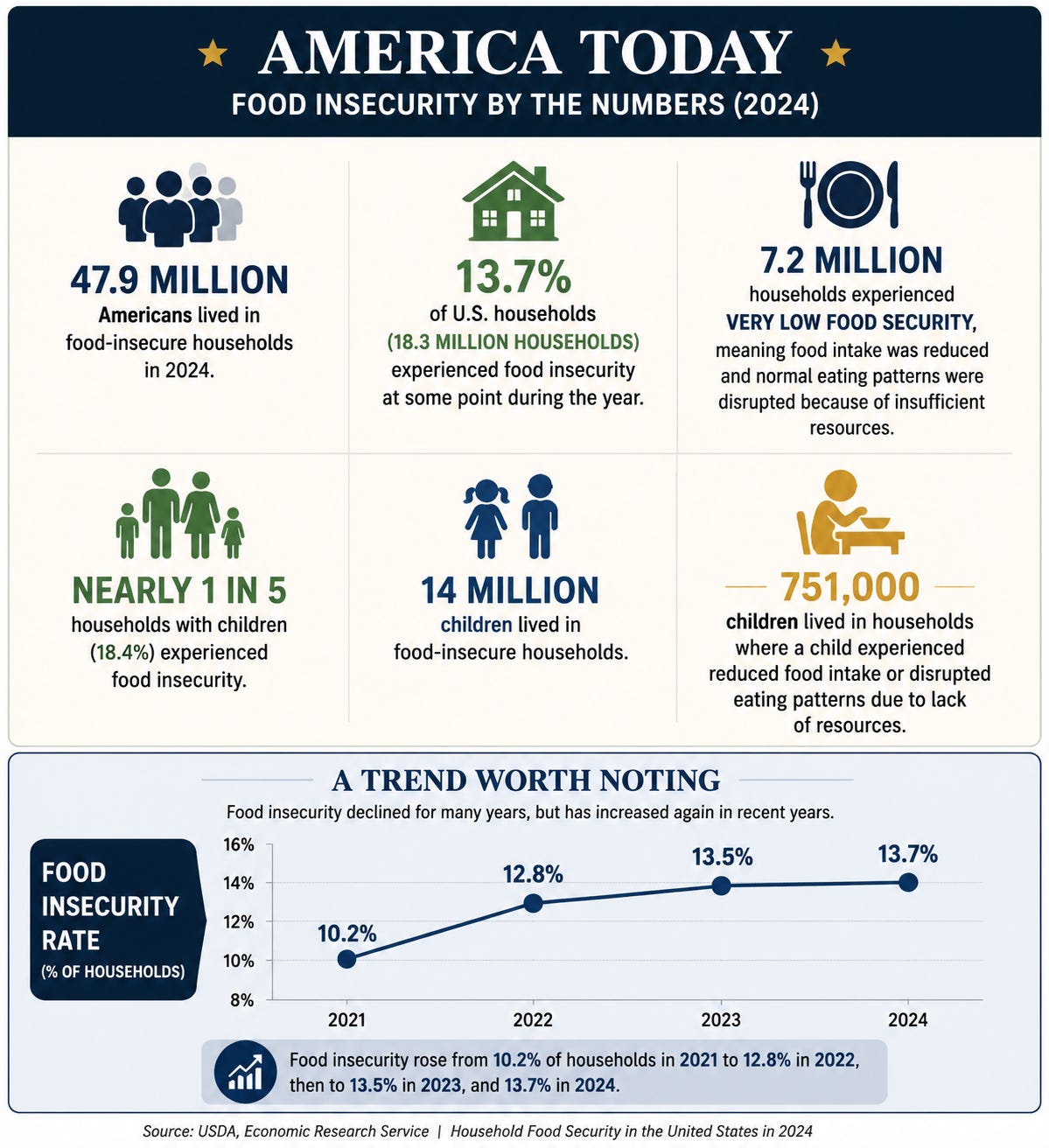
The contradiction is not new.
More than forty years ago, economist Amartya Sen confronted the same puzzle: how can people starve when food is available?
In his landmark work, Poverty and Famines (1983), Sen challenged one of the most enduring assumptions in food policy: that hunger is primarily the result of insufficient food. Studying the Bengal Famine of 1943, Sen found that food availability alone could not explain the scale of starvation. Food still existed. What failed were the systems through which people gained access to it.
Food is necessary for feeding a population.
But food alone cannot explain why populations go hungry.
The Hidden Architecture of Food Access
In his work, Sen identified what he called "entitlements," the mechanisms through which people gain access to food. He demonstrated that hunger could not be understood solely through the lens of food availability. Access mattered. But the systems that made access possible mattered even more.
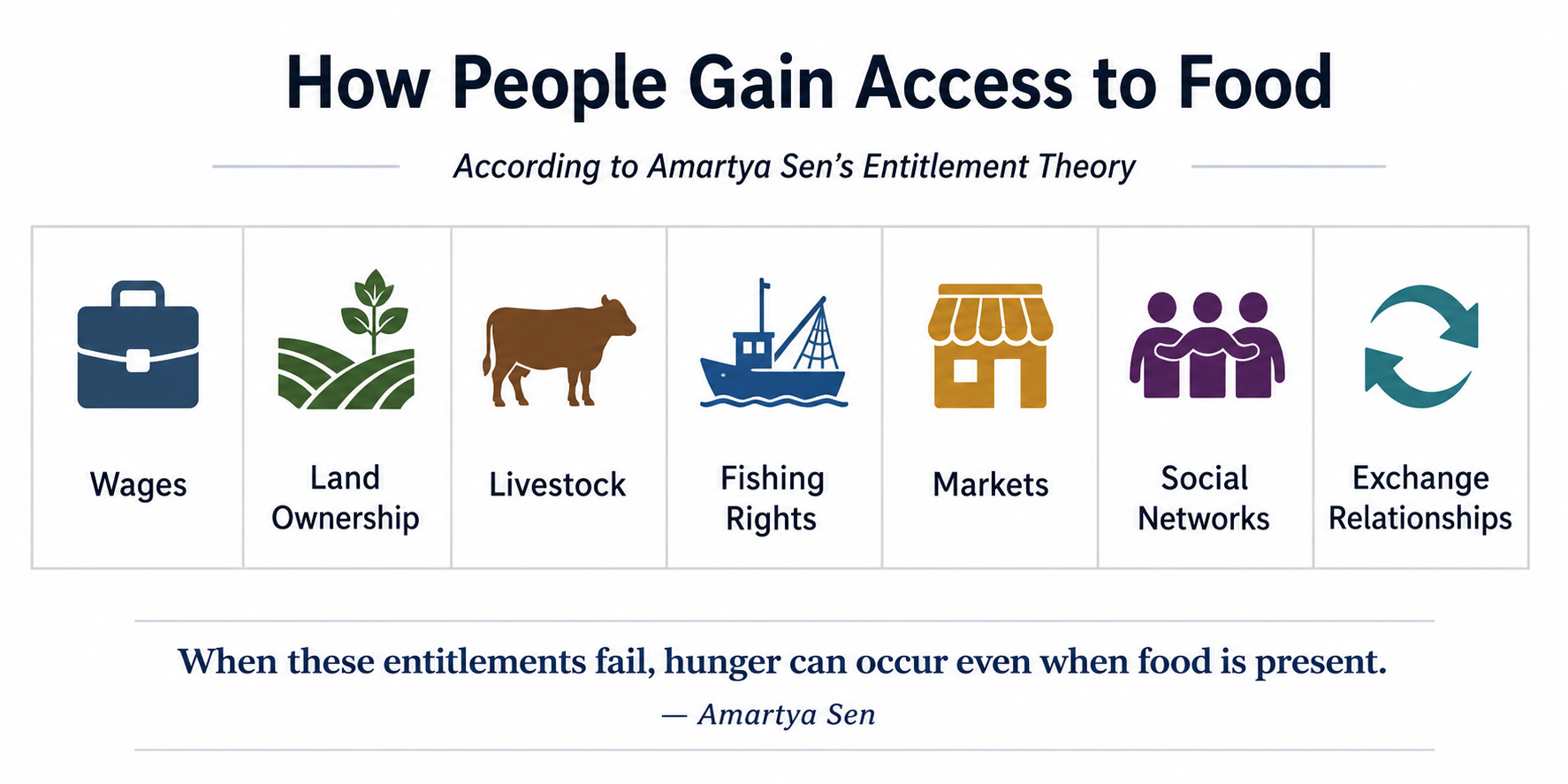
Nearly half a century later, much contemporary hunger policy remains focused on the same question Sen challenged decades ago:
Do people have food?
Food insecurity is generally defined as limited or uncertain access to adequate, safe, and nutritious food. As the dominant measure of hunger, it has shaped policy discussions, public investment, and intervention strategies for decades.
Far less attention has been paid to the systems that create, sustain, and govern access to healthy food.
The emphasis on access can be seen in public investment. Federal spending on USDA food and nutrition assistance programs was approximately $142.2 billion in FY2024 alone. This includes SNAP, WIC, school meals, food distribution programs, and related nutrition assistance efforts. Adjusted for inflation, federal spending on food and nutrition assistance has more than tripled since 1980, growing from $45.2 billion in 1980 to $142.2 billion in FY2024.
These programs alleviate suffering, improve lives, and provide critical support to millions of Americans. Research commissioned by USDA and later confirmed by more recent evaluations found that every dollar spent on prenatal WIC participation generated approximately $1.77–$3.13 in Medicaid savings through reduced complications, healthier births, and lower infant health care costs. Some evaluations report even larger savings. SNAP shows similar benefits, reducing the likelihood of being food insecure by roughly 30% and very food insecure by 20%.
For those who depend on these programs, these are more than datapoints. They are often the difference between a full pantry and an empty one, between a meal served and a meal skipped, between a child going to bed hungry and a child going to bed fed.
Despite their programmatic success, a fundamental problem remains:
After decades of investment and billions in public spending, why do nearly 50 million Americans still struggle to put enough food on the table?
The challenge is not that food assistance programs fail. The challenge is that hunger emerges from systems far more complex than food access alone can explain.
The current architecture is primarily organized around managing hunger rather than transforming the conditions that produce it.
Food assistance programs address an important part of the problem, but hunger emerges from a broader set of forces that extend beyond food access alone. Governance, production, distribution, economic relationships, community capacity, and local environments all shape whether communities can remain fed over time.
To understand that problem, we must move beyond food security and begin talking about food sovereignty. Not as a replacement for food assistance, but as a framework for understanding the deeper systems that produce hunger.
The Architecture of Food Access
Hunger cannot be understood apart from the systems through which people gain access to food.
Hunger persists when those systems fail: when land is inaccessible, when local production is absent, when social networks are severed, and when exchange relationships break down.
These systems form the architecture that makes food access reliable and sustainable. By focusing only on whether food is ultimately obtained, we miss the structural conditions that determine whether food access can be sustained.
This is where food sovereignty comes in.
A community may have food today while remaining entirely dependent on systems it does not control. Supply chains may stretch thousands of miles. Production may depend on imported inputs and global economies. Processing may occur far from the communities that consume the food. Decisions affecting local food access may be made by actors with no connection to the places they ultimately affect.
Food sovereignty does not ask whether food is available today. Food sovereignty asks who governs the conditions that determine whether food will be available tomorrow.
Sovereignty is not a guarantee of security. A community building toward sovereign food systems may face periods of transition, where local production is not yet sufficient, supply chains are being rebuilt, and new governance structures are finding their footing. That tension is real.
But chronic structural dependency carries its own form of insecurity, one that is slower, less visible, and often far more durable. A system that delivers food today while eroding the conditions that sustain food access tomorrow cannot be considered secure simply because it functions in the present.
The question is not whether food arrives on the dinner table today.
The question is whether the foundations upon which that meal depends will still be there tomorrow.
A Framework for Building Food Sovereignty
This raises an important question:
What would a food system designed around sovereignty rather than security look like?
Food sovereignty is often discussed in broad philosophical terms: local control, community ownership, self-determination, and democratic participation. Communities seeking to put these principles into practice are frequently left without a roadmap for implementation.
Communities do not implement principles. They implement systems.
To bridge that gap, Origins Reclaimed developed the Living Systems Food Sovereignty Framework (LS-FSF), a practical framework for making visible the conditions, relationships, and capacities that shape food sovereignty in practice. LS-FSF can be used to diagnose existing food systems, identify leverage points for change, and guide the development of more resilient and self-determining communities.
The figure below illustrates the core architecture of a food-sovereign system.
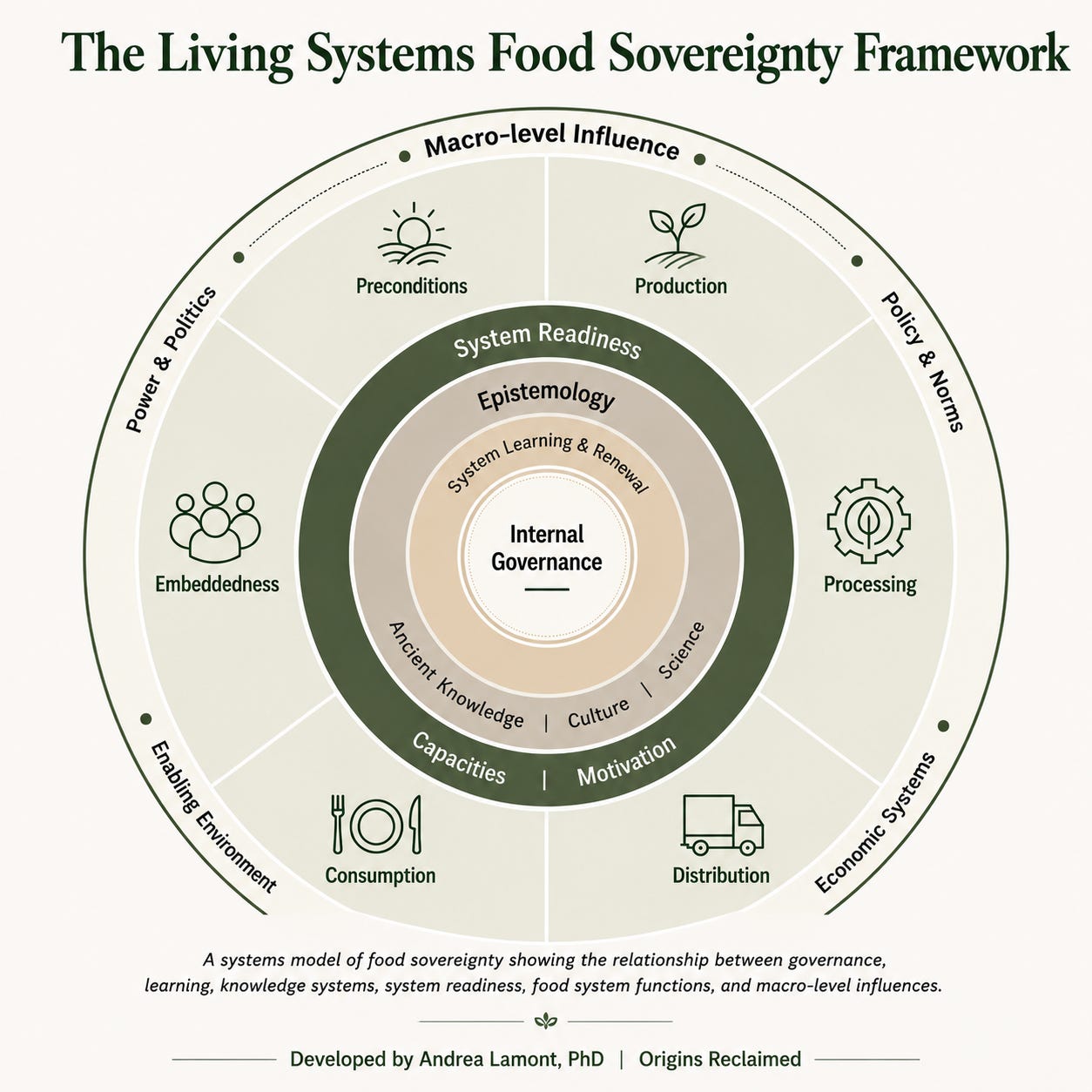
LS-FSF captures a food-sovereign system in its entirety, from the conditions that make production possible to the ways communities produce, process, distribute, consume, and sustain food over time.
It recognizes that food systems are not fixed arrangements but living systems that continuously adapt to the environments, institutions, and communities within which they are embedded.
LS-FSF draws on implementation science, a theoretical lineage rarely applied to food systems, to translate the philosophy of sovereignty into an actionable architecture for change. It brings together three distinct intellectual traditions: implementation science, which explains how systems change; systems theory, which explains how complex systems behave; and food sovereignty scholarship, which identifies the conditions communities must control to feed themselves sustainably.
Hunger is often addressed at the point where it becomes visible, while the conditions that produce it remain hidden. Systems that remain invisible cannot be understood, strengthened, or transformed.
By making visible the conditions, relationships, and capacities that shape food access over time, LS-FSF shifts the conversation from reacting to hunger toward understanding and building the systems that promote sovereignty.
No part of a food system changes in isolation. The architecture of a food system is not a sequence of independent stages, but a network of interdependent relationships characterized by continuous interaction and feedback.
Changes in production affect distribution.
Changes in governance affect participation.
Changes in community capacity affect resilience.
Food sovereignty is a living system shaped by human relationships, institutions, knowledge, and collective action.
A Living System Grows In The Light
Modern efforts to address hunger have largely focused on whether people have food. That question matters, but it only addresses part of the problem.
We have become highly skilled at measuring and debating outcomes while spending comparatively little time examining the systems that produce them.
The more important question is whether we are cultivating the conditions that allow communities to feed themselves, adapt to change, and exercise meaningful influence over the systems upon which they depend.
Hunger is often experienced at the level of the individual or family.
Its causes, however, are rarely confined there. They emerge from networks of relationships, institutions, incentives, resources, and environments that extend far beyond any single household, farm, or policy. Drivers of hunger are deeply intertwined with economic systems, governance structures, health outcomes, environmental conditions, and community life. Changes in one system reverberate through the others.
Strengthening food sovereignty therefore means strengthening the broader systems upon which communities depend.
Food-sovereign systems are not collections of isolated parts. They are interconnected wholes.
Food sovereignty challenges us to see food not merely as a commodity to be distributed, but as a living system to be stewarded.
Food security does not emerge by accident. It emerges from the conditions communities cultivate, the institutions they build, and the systems they choose to sustain.
Systems that remain invisible cannot be strengthened, governed, or transformed.
The systems we fail to see are often the systems that govern us most.
Every society inherits systems it did not create. Some nourish resilience. Others quietly produce the very problems they later attempt to solve.
The challenge is not simply to measure outcomes. It is to understand the systems that produce them well enough to improve them.
Everything else follows from there. 🐇🕳️
Building Food Sovereignty Beyond the Rabbit Hole
Origins Reclaimed was founded on a simple belief: lasting change happens when communities have the capacity to shape their own future. We work alongside local leaders, organizations, and communities to strengthen food systems, build resilience, and support practical pathways toward food sovereignty.
If you’d like to learn more about our work or explore opportunities to collaborate, visit originsreclaimed.org.
Andrea Lamont, PhD is an implementation scientist, co-developer of the R=MC² Readiness Framework, the Interactive Systems Framework for Dissemination and Implementation, and Getting To Outcomes-Technical Assistance. She is the co-founder and President of Origins Reclaimed. The Living Systems Food Sovereignty Framework is her most recent theoretical contribution.